Money is a tool everyone agrees to accept
It saves us from swapping one thing for another every time. We use it to exchange things, to compare prices, and to carry some of today's buying power into the future.
FORTUNE 101 · SUMMER COURSE

THE COURSE MAP
This is not a lecture about putting money away. Each week starts from a real choice a child can recognise, moves through observing, doing and looking back, and ends with something made that they can keep using.
Week 1 · Value and choice

If I get $100, how do I look after what I need now and the choices I want later?
Afterwards, the child can: Explain the difference between money and wealth with everyday examples, and finish a wealth map of your own with one smallest next step.Start with one sentence each: money is a tool for exchange that everyone accepts; wealth is any resource that helps you live and gives you choices.
Look for wealth outside the wallet: time, skills, health, relationships, knowledge and tools. Judge each by "what can it help me do", not only by its price.
Practise with "two stories about $100": enjoy it now, keep it for later, or some of both. There is no right answer, but you must be able to give a reason.
Ideas to understand
It saves us from swapping one thing for another every time. We use it to exchange things, to compare prices, and to carry some of today's buying power into the future.
Wealth is not only in the wallet. Money, belongings, time, knowledge, health, skills, tools and people you can trust may all be wealth, if they help us live, learn or get something important done.
Money helps us use or obtain some resources. Time, health, trust and real ability have to be looked after slowly. They cannot simply be bought.
Money helps us exchange, compare and store. It cannot decide what matters most to you. When you want to buy something, ask: what happens if I don't? How long will it last? Does it connect to something I care about?
Try another example
Start with $100. Use it to split it into "now" and "later", and new possibilities open.
Try another example: with a different resource, what you can do and what becomes possible are different too.
Practise with an example
You get a pleasure or meet a need today. You also have fewer choices available later.
Leave room for a goal, a surprise, or a small thing that helps someone or creates value.
For example, use part now and keep part. What matters is the reason, not a fixed split.
Week 2 · Creating value

Whose small problem can I solve, and do it honestly and well?
Afterwards, the child can: Make a one-page mini business: who it is for, the problem, the idea, how you tested it, and simple income and costs.Start close by: what small problem keeps coming up for family, neighbours or classmates? "Selling things" is not the only answer.
Say the idea in one sentence: who I help, and the safe, honest way I make things a little better.
Ask 3 people before spending on materials. Work out income, cost and profit separately.
Ideas to understand
Notice a need, propose a way, put in time and materials, deliver, and listen to feedback. Income comes from real value you created.
Sell 5 bracelets at $10 each and income is $50. Beads and paper cost $20, so profit is $30, and that is before counting your own time.
Practise with an example
Start with A messy book corner. Use it to ask the teacher, then add labels, and new possibilities open.
Ask first, then do, then listen to feedback. Practise where family and school allow, and put safety first.
Week 3 · Sharing out and planning
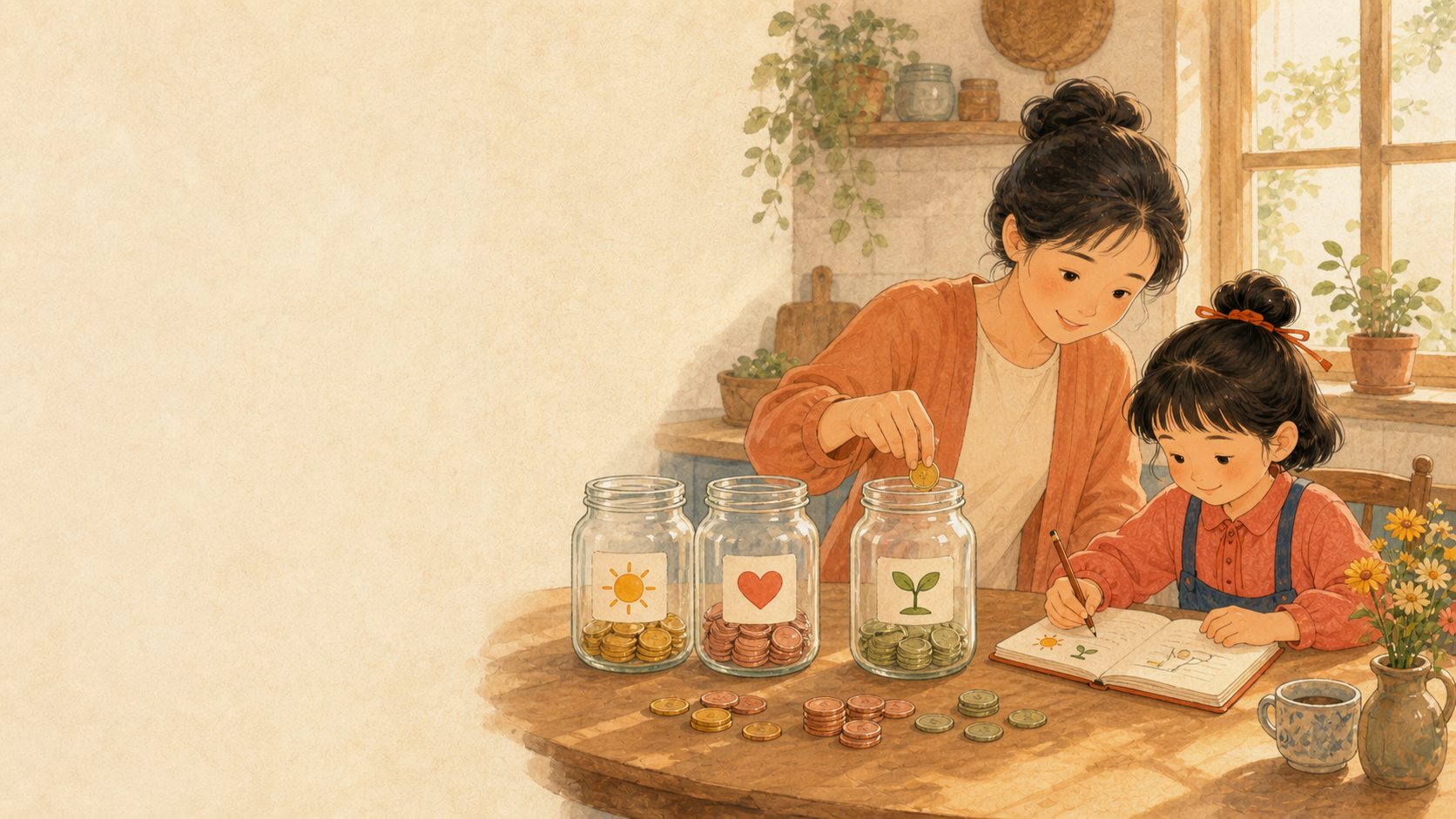
If every bit of money has a job, what do I want to look after first?
Afterwards, the child can: Keep a 7-day choice diary and find one time when pausing before deciding changed what happened.Use three jars for a real or pretend amount: for now, for sharing, for later. The split depends on the family and the goal.
Pick one moment when you wanted to spend, and work out where the urge came from: an ad, friends, boredom, or a real need?
Review after a week: what did the choice help with? Would you do it differently next time?
Ideas to understand
For now: meet needs and enjoy planned treats. For sharing: family, community or something you care about. For later: saving for goals, surprises and bigger choices.
Before a plan, everything you want feels urgent. After a plan, you know what matters most, and what you will give up for a while to get it.
Practise with an example
Start with $30 pocket money. Use it to split it: now, sharing and later, and new possibilities open.
There is no right split. Try another situation, see whether your plan changes, and say why.
Week 4 · Patience and growth

From the same start, why does leaving it longer and following the rule more times give a different result?
Afterwards, the child can: Run the paper cup growth experiment and explain in your own words that "the starting amount and its past growth both join the next round".Use chips or beans: add 10% each round and leave the new ones in the cup too. This is to understand a pattern, not a promise of returns.
Change the starting time, the growth rate, or take some out midway, and record the total each round. Let the child guess first, then count.
Discuss why the real world does not grow every round: results can be bad, and money needed soon should not join a game with big swings.
Ideas to understand
In the toy model, 100 growing 10% a round for three rounds becomes 110, 121, then 133. The earlier you start, the more time can do.
A return is what someone pays for using your money. Risk means the result may be worse than expected, and you may even lose what you put in. Spreading money out reduces the risk of having it all in one place. Money needed soon should not be exposed to big swings.
Practise with an example
Start with 100 early chips. Use it to add by the rule and leave them in, and new possibilities open.
Change the starting time, the growth rate or take some out midway, and the result changes. In the real world it can also fall or be lost.
Week 5 · Protection and judgment

What signals tell me not to tap right now?
Afterwards, the child can: Make a scam detective card and rehearse one sentence for saying no that you can really say out loud.Look at three familiar cases: a limited-time game item, automatic renewal and a "guaranteed profit" message. Circle the pressure, exaggeration, secrecy and requests for private details.
Practise four steps: leave the screen for 10 minutes, take a screenshot, check a second source, tell an adult you trust.
One person plays the seller, the other practises saying no: "I won't decide now. I need to check with my family first."
Ideas to understand
Paying on a screen is real spending. Limited-time offers, prize draws and automatic renewals in games and live streams are designed to rush you. Borrowing and credit mean using today and paying back later, usually with an extra cost.
Pause for at least 10 minutes. Find a second source and check the real price and conditions. Have an adult you trust look with you. Never send verification codes, passwords, your address or payment details.
Practise with an example
Start with A "10 min left" item. Use it to leave the screen, screenshot and check, and new possibilities open.
Try the four steps on another case: leave the screen, take a screenshot, check a second source, tell an adult you trust.
Week 6 · Meaning and responsibility

If wealth works for what matters, where does my family want to use it?
Afterwards, the child can: Agree a small three-month plan with your family: one goal, one waiting rule, one conversation and one way of giving.Discuss what wealth can do for us, and name what it cannot buy: time, health, trust and relationships all have to be looked after.
Choose one three-month goal the whole family is willing to work on. It can be an experience, learning, preparing for surprises, or helping someone.
Agree on a 20-minute talk each month: check progress, tell the story of one choice, adjust the plan. The plan can change. The reasons should be kept.
Ideas to understand
Wealth can cover basic needs, pay for learning and experiences, handle surprises, and help the people and causes we care about. Health, time, trust, ability and relationships need continuing care and cannot simply be bought.
Practise with an example
Start with A shared family goal. Use it to agree a small 3-month plan, and new possibilities open.
Goals can change. The reasons should be kept. Try choosing one small thing with your family that is worth doing together.
GRADUATION CHALLENGE
Pick Choose the one idea you most want to keep.
Ask Give your audience a real choice to answer.
Show Use a story, an object or a small game.
I will make money work for what matters.
Create value first, then make choices I can give reasons for, and leave some room for the future and for others.
The course is heavy on activity and light on jargon. Between 6 and 12, children are forming money habits and a sense of what counts as normal. Goals, waiting, self-control, comparing and looking back transfer further than memorising product names. Children need to explain their reasons, not guess the adult's answer. What adults say and do every day becomes the rule children observe.
DISCUSSION
Join the discussion
Share a thought or question. Comments publish immediately; add your email only if you would like reply notifications.Be the first to start the conversation.